January 29th, 2010.
I'm skipping the American Popular Music time-suck to spend some time focusing on my thesis. So far, I've two blank word documents; the first entitled "Why I Hate School" and the second "American Aprioristic Urban Pastoralism: Reasons for Academically Induced Self-Flagellation" of which I'm still working out the meaning. It came to me in a dream, so, you know, it must be profound.
Research is proving difficult. The Interlibrary Loan office keeps canceling my requests because they're "too new" or "we have it at the library but it'll be checked out until September." If it weren't "free" I'd suspect they were trying to ruin me. I've requested the following books: Documentary screens : non-fiction film and television by Keith Beattie and First person Jewish by Alisa Lebow. Of course those are the only two the lovely library could procure. I was hoping a book might give me some kind of direction. I'm sort of, if not entirely, directionless. I'm realizing what I'm doing is frivolous and trite and am out of ideas on how to fix it. So now my efforts will be toward narrowing down a topic without trying to sound like an asshole.
In my production efforts I've made a schedule of movies and readings to go along. It's pretty much like being in class, but without someone talking at me. For next week I've arranged a Camp-a-thon. I'm reading lady-boner-inducing Susan Sontag's "Notes on Camp" of which I plan to compare with the documentary Paris is Burning and possibly The Eyes of Tammy Fay or Wigstock. Or maybe I'll stay up all night and watch them all while wearing my velour cheetah print smock and matching heels.
Tonight, on a more serious note, I will be watching The Cats of Mirikitani (not meaning to sound flippant) about a Japanese artist who paints cats. I'm excited for this one.
And now is time for the mandatory time-suck of the Salvo.
Doherty out.
Friday, January 29, 2010

Tuesday, January 26, 2010
Herb and Dorothy part I
I just finished watching Herb and Dorothy, a charming documentary released last year from the director Megumi Sasaki who had spent the last twenty years in New York cultivating a production company with roots in independent journalism. This informs the straightforward, unbiased presentation of Herb and Dorothy Vogel as an elderly couple living in a small New York city apartment impregnated with Minimal, Conceptual, and Modern art. The Vogel's story comes as a refreshingly purist approach to art collecting; if a piece moves them, they buy it. But only to display within their one bedroom shoebox apartment. 
What Sasaki meant to create (via her interview with Elston Gunn) was an alternate view of the Vogels (as opposed to their media coverage in the 80s and 90s) as unlikely philanthropists, but it fails in its attempt to convey what Sasaki calls the "much more profound message in Herb and Dorothy's story" but repackages the precedented years of media coverage and speculation prior to the official documentary. Overall, Herb and Dorothy was sweet yet unaffecting. I may be being a little cold hearted here, but I felt the movie was reduntant and didn't say anything aside from what I could find on wikipedia. 2 out of 5 best Chuck Close anecdote.
The Vogels' supposed magic eye for worthwhile artworks brought me to question the idea of taste and the value thereof. So I took to reading Edmund Burke's On Taste, although against my better judgement. I made it 6 paragraphs in and was so annoyed by his assumptions I quit reading. I didn't really learn anything about taste or the absurd rules and regulations Burke asserts it has. I left it more confused and enraged than when I started. Burke claims that taste, along with the senses, imagination, and judgement, can be quantified and logically reduced to a common denominator among all humanity. I disagree. Taste is not definable or reducible to universal exactitude. As Postmodernity has taught us, meaning and truth are never attainable as they are infinitely deferred. I agree. In terms of the Vogels, the volatility and meaning of taste is equally illusive. Their passively simple "because we like it" articulations of their buying motives leaves us to question and wonder. Their lack of verbal articulation about visual art alludes to an unspoken understanding of the artist and idiosyncratic appreciation of the artwork. Is this what artists want of their patrons, admirers, or consorts? As an art historian in training, I'd like to know some day, but doubt I ever will.
What Sasaki meant to create (via her interview with Elston Gunn) was an alternate view of the Vogels (as opposed to their media coverage in the 80s and 90s) as unlikely philanthropists, but it fails in its attempt to convey what Sasaki calls the "much more profound message in Herb and Dorothy's story" but repackages the precedented years of media coverage and speculation prior to the official documentary. Overall, Herb and Dorothy was sweet yet unaffecting. I may be being a little cold hearted here, but I felt the movie was reduntant and didn't say anything aside from what I could find on wikipedia. 2 out of 5 best Chuck Close anecdote.
The Vogels' supposed magic eye for worthwhile artworks brought me to question the idea of taste and the value thereof. So I took to reading Edmund Burke's On Taste, although against my better judgement. I made it 6 paragraphs in and was so annoyed by his assumptions I quit reading. I didn't really learn anything about taste or the absurd rules and regulations Burke asserts it has. I left it more confused and enraged than when I started. Burke claims that taste, along with the senses, imagination, and judgement, can be quantified and logically reduced to a common denominator among all humanity. I disagree. Taste is not definable or reducible to universal exactitude. As Postmodernity has taught us, meaning and truth are never attainable as they are infinitely deferred. I agree. In terms of the Vogels, the volatility and meaning of taste is equally illusive. Their passively simple "because we like it" articulations of their buying motives leaves us to question and wonder. Their lack of verbal articulation about visual art alludes to an unspoken understanding of the artist and idiosyncratic appreciation of the artwork. Is this what artists want of their patrons, admirers, or consorts? As an art historian in training, I'd like to know some day, but doubt I ever will.
Tuesday, January 19, 2010
I like my women just a little on the trashy side.
Heiresses in terrycloth head wraps have nothing on waitresses in Dolly Parton wigs. Yes, that is a Confederate Railroad reference. What? You don't know (or care) who Confederate Railroad is? My humor is lost on the young and cultured.
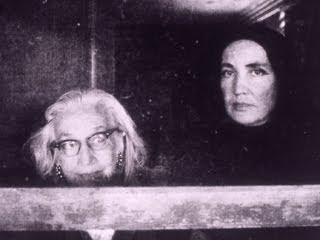
Tonight's interest is in the 1975 documentary Grey Gardens directed by Albert and David Maysels. And, as I'm sure you all were wondering, they do have a fansite.
IMDB synopsizer Huggo sez:
Seventy-nine year old Edith Bouvier Beale and her fifty-six year old daughter, Edith 'Little Edie' Bouvier Beale, are Jacqueline Kennedy's aunt and cousin. Living alone with several cats, fleas and raccoons (the latter, wild, which live in the attic but who Edie feeds), the Beale's are discovered living in filth and squalor in Grey Gardens, their 28-room family mansion located in East Hampton, Long Island, the mansion which doesn't even have running water. Edie moved home twenty-four years earlier to care for her ailing mother.
[Hilarity ensues]
In my efforts to break away from the Jewish gentlemen's club I was backing myself into my newest attempt was to branch out and hear what the ladies had to say. But in doing so I was sucked back into the Maysles vortex; a vortex, I might add, that I never really wanted to leave (See the Maysles' link in the sidebar). They do a fantastic job, as always, but I'm not here to blabber on about them.
"The best emotions to write out of are anger and fear or dread. The least energizing emotion to write out of is admiration ... because the basic feeling that goes with admiration is a passive contemplative mood" --Susan Sontag
Alright, I'll be out with it; I am terrified of the Edies and dread the day when my mother and I transmogrify into them. The first day I read about Grey Gardens was years ago in an article on the prolific careers of the Maysles and their remarkable cinéma vérité story of Jackie O's aunt and cousin living in near squalor with cats, raccoons, and in pools of their own detritus. It made me think of the basement in my mother's house (she's going to kill me for making this comparison, but it has to be done). Of course we never had their kind of money or self-righteous disdain for hoi polloi and having affairs with the rich and famous, but we are more than a bit on the odd-ball side and tend to be nostalgic pack rats who love cats and running around in our skivvies. We aren't full blown Bouviers, but are unhatched eggs of their psychological progeny. Watching those two felt like living the end of 2001: Space Odyssey. Horrified, I called the Moms to tell her to rent it immediately. She could only find the new Drew Barrymore, Jessica Lang version (still haven't seen it, but wasn't Drew Barrymore adorable at the Golden Globes? aside from her hair of course, I mean, blah!) Anywho, turns out, the Moms didn't see the resemblance as a problem. And why should she? The mother had it made: lounging in bed all day, freely disrobing as she pleased, and entertaining Jerry, the young handyman whom Little Edie called the Marble Faun. And as Big Edie asserts, "I haven't got any warts on me!" No warts! She was the complete package. 
This is why I'm dropping the ax now, moving out of the state and leaving the cat (maybe). Am I afraid I'm squandering my potential? You bet. And this is what Little Edie partially represents to me: the harsh reality of letting go of one's ambitions. But she also represents much more; she was a larger than life character living on her own mad stage and for that I love her. Their entire existence in contradictory in this way; they live freely by their own rules, but are trapped by the lives they couldn't escape. Little Edie frolicked gleefully around the house, but also spoke of her hatred of confinement. Free, but emprisoned. Living, but dead. Post-aristocratic Schrodinger's cats. I also love this movie for that. And apparently so do gay men.
In 2006, the delightfully gay trio Doug Wright, Scott Frankel and Michael Korie adapted the film into a musical which went on to win several awards. In fact, while researching I found that Grey Gardens has reached an iconically gay stature. The Bouvier-as-outsiders and gay-as-outsider correlation swiftly brought the film into the Gay, Lesbian, Bisexual, and Transgender (GLBT) cultural repertoire. In his essay "The Gayness of Grey Gardens", Matthew Hays quotes Albert Maysles:
"There was this weird kind of paradox about them being outsiders. They also became these ultimate insiders because they got to be in the film. So how did they do that? Outsiders often want desperately to be insiders. The women in Grey Gardens got both. I suppose that's true of homosexuals: they would like to be accepted for who they are, but maintain their individuality."
The gay cult following accrued by the film may also have its roots in a subject I've briefly mentioned in other blogs about the role and response of the audience. How the subjects are portrayed and how the audience reacts are manifest in several recurring ways in documentary films especially dealing with "eccentrics" or "outsiders." The bathetic moments are especially telling of the nature of the film. Even though I found the Edies hilarious and possibly insane, at no moment did I feel a sense of mockery. Little Edie was able to illuminate their absurd situation through freely choreographed dance numbers in their shambly old house. An air of camp lingers around those scenes--another issue used in Hays' gay attraction agrument. But for all the seemingly gay over/undertones Grey Gardens is relatable on an elementary humanistic level.
Now, please watch or rewatch Grey Gardens at your leisure and give a sheynem dank to the Maysels for making another fantastic film.
Your humble viewer,
erin d.
The performance on the Tony's.
In 2006, the delightfully gay trio Doug Wright, Scott Frankel and Michael Korie adapted the film into a musical which went on to win several awards. In fact, while researching I found that Grey Gardens has reached an iconically gay stature. The Bouvier-as-outsiders and gay-as-outsider correlation swiftly brought the film into the Gay, Lesbian, Bisexual, and Transgender (GLBT) cultural repertoire. In his essay "The Gayness of Grey Gardens", Matthew Hays quotes Albert Maysles:
"There was this weird kind of paradox about them being outsiders. They also became these ultimate insiders because they got to be in the film. So how did they do that? Outsiders often want desperately to be insiders. The women in Grey Gardens got both. I suppose that's true of homosexuals: they would like to be accepted for who they are, but maintain their individuality."
The gay cult following accrued by the film may also have its roots in a subject I've briefly mentioned in other blogs about the role and response of the audience. How the subjects are portrayed and how the audience reacts are manifest in several recurring ways in documentary films especially dealing with "eccentrics" or "outsiders." The bathetic moments are especially telling of the nature of the film. Even though I found the Edies hilarious and possibly insane, at no moment did I feel a sense of mockery. Little Edie was able to illuminate their absurd situation through freely choreographed dance numbers in their shambly old house. An air of camp lingers around those scenes--another issue used in Hays' gay attraction agrument. But for all the seemingly gay over/undertones Grey Gardens is relatable on an elementary humanistic level.
Now, please watch or rewatch Grey Gardens at your leisure and give a sheynem dank to the Maysels for making another fantastic film.
Your humble viewer,
erin d.
The performance on the Tony's.
Friday, January 15, 2010
Boys club

As much as I wish I had the time to troll the internet (of which I could be using right now to do so, but that's beside the point) in search of documentaries, I'd like to know what my humble reader(s) is(are) watching. And since my past entries have pretty much been kosher sausage fests, I'd like to choose a documentary with more of a feminine angle. I'm just going to say it: girls weird me out. I've never related to them aside from the boobs and Mao and think that maybe a documentary could act as an ersatz "girlfren" and make me feel slightly less gauche about being a girl. Any suggestions to help me fill this psychosexual void (which used to be filled by Designing Women) or whatever would be much appreciated.
Documentary+ladies-the "p" word= sort of what I'm looking for at the moment.
Friday, December 25, 2009
Blogged in flames

Anvil!
Sidenote: We are listening to Metal on Metal now while making soup. I highly recommend "Mothra" with all its role playing hanky panky innuendo. The latter part may be of my own insertion.
Sidenote 2: I was talking with a co-working who is deeply into Viking metal about Anvil. I told him the movie was great and that being a fan of metal he may really enjoy it. He said he listened to half of one song and almost punched a librarian because it was so bad. That said, you should listen to Anvil.
I'm going to write this without trying to sound sappy, but I find it difficult when writing about heavy metal. The five or so years I've been forcefully exposed to the genre by former boyfriends and through this I have gained enough respect and admiration (and doggone it, I think I might actually like some of it) for the musicians that I was really looking forward to watching Anvil: The Story of Anvil before it came out. Along with a healthy obsession with Spinal Tap, I was mentally prepared for an absurdly comedic tale of the rock band that kind of was, but then wasn't, but sort of is in Japan. In other words, I expected a group of struggling musicians trapped in their own fantasy worlds of Heavy Metal Parking Lot to be paraded around for the audience to laugh at, much in the vein of American Movie (review in progress). However, I found these folks, because honestly they are very folksy people, to be genuinely interesting and entertaining. Because, after all, they just want to entertain and play the music that they love and they're going through the hardships of middle age. The relation ship between Lips and Robb is especially touching. They argue of mismanagement and recording "shit takes" but in the end they sob on each others shoulders like junior high BFFs. Enough of the sweetness.

“Thumbs will twist. Can you resist? Thumb hang!”
With the heavy metal tropes of Satanism, moral disrepute, and the authoritative don’t give a shit, the guys of Anvil are angelically well tempered, driven by the passion in their hearts, and genuinely good people. This makes the fall of Anvil empire difficult to agree with and even harder to watch as Lips and the crew put forth all their efforts into the chance of making a comeback with a European tour. It’s almost sickening, really. One may wonder how such kind, devoted fellas could have been standing on the precipice of stardom in the mid 80s but are banished to hoi polloi day jobs as caterers for public schools and construction workers. Anvil becomes their alter ego and escape from reality. When expressing his lackadaisical opinion of his catering job, Lips confesses, “Anvil gives me happiness” and the drummer Robb Reiner comments of his construction job, “…I would rather be on stage. My other jackhammer is a drum set. ” Their families are more or less encouraging, Robb’s wife the most encouraging as the glam hair and tight black tank top leave their residue from 1985. Lips’s wife is surprising mom-like and normal in a bank teller sort of way. She gives no inclination to her husband’s dream of becoming a demi-god of Canadian metal.
On a brief side note, as a lover and student of art, Robb Reiner’s paintings featured briefly in the film are worth checking out. Sort of Edward Hopper meets De Chirico.
“I’d rather be a king below than a servant above, I’d rather free and hate than a prisoner of love; 666”
The fans are a crucial aspect of the film. In the beginning we are introduced to two “original Anvil fans” at a local bar; one man in a Flyers jersey and a salt n’ peppery bearded man who drinks a beer through his nose on stage. They recite lyrics in tandem with the band and liven the otherwise taciturn venue. The fervor of which these two approach Anvil is reserved for large metal festivals and the Japanese. Nearly one flop show after the next during their European tour and after disheartened return home the fan base doesn’t seem to be there, or anywhere. That is until they are invited to return to Japan. SPOILER ALERT. Of course the footage of Anvil playing to a Woodstockian crowd at a Tokyo festival in 1984 that had began the film is now juxtaposed next to their triumphal return to Japan as they are playing to a comparably large crowd some 20 years later at the end of the film while promoting their latest album "This is 13"; a name which pales in comparison to their previous albums "Metal on Metal", "Forged in Fire", "Strength of Steel", "Hot and Heavy", and "Backwaxed" which takes its title from a song about ejaculating on someone's back.
“It goes far beyond writing a good song It has nothing to do with the song it has to with a matter of attitude, what you’re willing to settle for, who you’re willing to work with, and having a good time with my life, with enjoying my life; That that’s the most expensive thing in life, and the most valuable things in life is your relationships, the people that you know, the places you’ve been, and the experiences that you’ve had.”
School Love
Sidenote: We are listening to Metal on Metal now while making soup. I highly recommend "Mothra" with all its role playing hanky panky innuendo. The latter part may be of my own insertion.
Sidenote 2: I was talking with a co-working who is deeply into Viking metal about Anvil. I told him the movie was great and that being a fan of metal he may really enjoy it. He said he listened to half of one song and almost punched a librarian because it was so bad. That said, you should listen to Anvil.
I'm going to write this without trying to sound sappy, but I find it difficult when writing about heavy metal. The five or so years I've been forcefully exposed to the genre by former boyfriends and through this I have gained enough respect and admiration (and doggone it, I think I might actually like some of it) for the musicians that I was really looking forward to watching Anvil: The Story of Anvil before it came out. Along with a healthy obsession with Spinal Tap, I was mentally prepared for an absurdly comedic tale of the rock band that kind of was, but then wasn't, but sort of is in Japan. In other words, I expected a group of struggling musicians trapped in their own fantasy worlds of Heavy Metal Parking Lot to be paraded around for the audience to laugh at, much in the vein of American Movie (review in progress). However, I found these folks, because honestly they are very folksy people, to be genuinely interesting and entertaining. Because, after all, they just want to entertain and play the music that they love and they're going through the hardships of middle age. The relation ship between Lips and Robb is especially touching. They argue of mismanagement and recording "shit takes" but in the end they sob on each others shoulders like junior high BFFs. Enough of the sweetness.

“Thumbs will twist. Can you resist? Thumb hang!”
With the heavy metal tropes of Satanism, moral disrepute, and the authoritative don’t give a shit, the guys of Anvil are angelically well tempered, driven by the passion in their hearts, and genuinely good people. This makes the fall of Anvil empire difficult to agree with and even harder to watch as Lips and the crew put forth all their efforts into the chance of making a comeback with a European tour. It’s almost sickening, really. One may wonder how such kind, devoted fellas could have been standing on the precipice of stardom in the mid 80s but are banished to hoi polloi day jobs as caterers for public schools and construction workers. Anvil becomes their alter ego and escape from reality. When expressing his lackadaisical opinion of his catering job, Lips confesses, “Anvil gives me happiness” and the drummer Robb Reiner comments of his construction job, “…I would rather be on stage. My other jackhammer is a drum set. ” Their families are more or less encouraging, Robb’s wife the most encouraging as the glam hair and tight black tank top leave their residue from 1985. Lips’s wife is surprising mom-like and normal in a bank teller sort of way. She gives no inclination to her husband’s dream of becoming a demi-god of Canadian metal.
On a brief side note, as a lover and student of art, Robb Reiner’s paintings featured briefly in the film are worth checking out. Sort of Edward Hopper meets De Chirico.
“I’d rather be a king below than a servant above, I’d rather free and hate than a prisoner of love; 666”

The fans are a crucial aspect of the film. In the beginning we are introduced to two “original Anvil fans” at a local bar; one man in a Flyers jersey and a salt n’ peppery bearded man who drinks a beer through his nose on stage. They recite lyrics in tandem with the band and liven the otherwise taciturn venue. The fervor of which these two approach Anvil is reserved for large metal festivals and the Japanese. Nearly one flop show after the next during their European tour and after disheartened return home the fan base doesn’t seem to be there, or anywhere. That is until they are invited to return to Japan. SPOILER ALERT. Of course the footage of Anvil playing to a Woodstockian crowd at a Tokyo festival in 1984 that had began the film is now juxtaposed next to their triumphal return to Japan as they are playing to a comparably large crowd some 20 years later at the end of the film while promoting their latest album "This is 13"; a name which pales in comparison to their previous albums "Metal on Metal", "Forged in Fire", "Strength of Steel", "Hot and Heavy", and "Backwaxed" which takes its title from a song about ejaculating on someone's back.
“It goes far beyond writing a good song It has nothing to do with the song it has to with a matter of attitude, what you’re willing to settle for, who you’re willing to work with, and having a good time with my life, with enjoying my life; That that’s the most expensive thing in life, and the most valuable things in life is your relationships, the people that you know, the places you’ve been, and the experiences that you’ve had.”
School Love
Thursday, November 12, 2009
Best Boy

Let's save some agony and cut to the IMDB chase:
Portrait of a family in transition: a mother, a father, and their son, their "best boy." Pearl and Max Wohl live in Queens with Philly, their cheerful, engaging, and mentally-disabled son. For 50 years Pearl and Max have provided a loving home for Philly, but they're aging, Max is ailing, and they must figure out what's to happen to Philly when they can no longer care for him. Are there options besides an institution? Philly's cousin is Ira Wohl, whose camera follows the family as Philly takes steps into the wider world. Written by {jhailey@hotmail.com}
All this time while watching documentaries I felt a dissonance between what was going on behind the camera and what I was watching. I always felt the film crew looking on the people with impersonal voyeuristic intentions, even the do-no-wrongers, the Maysels. With films like American Movie, Speedo, and 
The intrafamilial relationships were the most interesting parts of Best Boy that explored the intricate workings of a family living day-to-day with a special needs child, even though Phillip cannot technically be referred to as child being in his 50s. His mother, Pearl, who eerily reminds me of my grandmother, exercises skillful and loving care of the family, even though she and Phillip’s father, Max, break their façade of unfettered elation in the presence of Phillip. During a moment when Ira and

I don’t want to talk about this film in terms of making you think about what we take for granted or to take away any moral, but rather to view this film as an example of the human condition (that’s right, I said it) and the way in which it can be respectfully and thoughtfully provoking without the harsh melodrama of self-aware nincompoops (don’t get me wrong, I love self-aware nincompoops, but sometimes I like to keep a classy base).
Aside from being a nice change from the other films I’ve been watching, Best Boy was just down right charming and heartwarming (although heartbreaking at the end). Phillip won me over. The moment he was singing “If I Were a Rich Man” with Zero Mostel and completely oblivious to any concept of celebrity was fantastic. There were rare moments when Phillip wasn’t smiling or oozing contentment. Is this starting to sound like a eulogy? He has a strong outgoing personality that really shines in Best Boy and I highly recommend viewing it. Amen.
Apparently you can watch the whole thing on YouTube.
Sunday, November 8, 2009
A brief aside written at 4am.
Dear fellow travelers,
I know you've been patiently following me down the documentarial path and I express some gratitude, yet it's now time to stop by the wayside, walk into the tall grass and meander down into that muddy gully that is Exploitation Cinema. Let us tread lightly through its shallow waters being careful not to mame or mangle any of the decrepit life that lurks and slithes in what is debatably mud. Let's fish gently in the tepid waters for the gornatodes hidden under clods of taboo (am I taking this analogy too far?). We will breath in the air heavy with sex and death which I imagine smells a lot like Gauguin's Monao Tupapau. We will bite into the hard sensationalist candy shell to get to the perverse and gory nougat (suspend your disbelief and imagine nougat inside a candy shell, gross, I know). Please also suspend the disbelief in trying to relate this entry to the rest of the site, I assure you it has nothing to do with documentaries. It does, or would like to, discuss briefly and encourage the viewing of exploitation films.
Last week I watched Cannibal Holocaust. It was terrible. But the fact that it exists within a larger genre fascinated me. It was like stumbling across the first circle of hell and realizing there were 8 more circles below me filled with unspeakably graphic and lurid content. So immediately after viewing I went to the library to order a slew of other films like it. For now, I'm trying to get a sampling of all the sub-genres. So on my queue I have Blacula, Mondo Cane, The Street Fighter, and 2000 Maniacs. Suggestions would be fantastic. I feel like I'm arriving a little 40 years late on the bandwagon, but I can't blame late conception for everything. Also, I suppose the interest has been sparked with my new (sort of) fascination with death and the ways in which different cultures confront the issue which is equally important as the way they view sex. I suppose this entry also functions as a warning in that I will be writing some low-brow and lurid entries on this topic in the future.
sincerely,
your humble fabulist
I know you've been patiently following me down the documentarial path and I express some gratitude, yet it's now time to stop by the wayside, walk into the tall grass and meander down into that muddy gully that is Exploitation Cinema. Let us tread lightly through its shallow waters being careful not to mame or mangle any of the decrepit life that lurks and slithes in what is debatably mud. Let's fish gently in the tepid waters for the gornatodes hidden under clods of taboo (am I taking this analogy too far?). We will breath in the air heavy with sex and death which I imagine smells a lot like Gauguin's Monao Tupapau. We will bite into the hard sensationalist candy shell to get to the perverse and gory nougat (suspend your disbelief and imagine nougat inside a candy shell, gross, I know). Please also suspend the disbelief in trying to relate this entry to the rest of the site, I assure you it has nothing to do with documentaries. It does, or would like to, discuss briefly and encourage the viewing of exploitation films.
Last week I watched Cannibal Holocaust. It was terrible. But the fact that it exists within a larger genre fascinated me. It was like stumbling across the first circle of hell and realizing there were 8 more circles below me filled with unspeakably graphic and lurid content. So immediately after viewing I went to the library to order a slew of other films like it. For now, I'm trying to get a sampling of all the sub-genres. So on my queue I have Blacula, Mondo Cane, The Street Fighter, and 2000 Maniacs. Suggestions would be fantastic. I feel like I'm arriving a little 40 years late on the bandwagon, but I can't blame late conception for everything. Also, I suppose the interest has been sparked with my new (sort of) fascination with death and the ways in which different cultures confront the issue which is equally important as the way they view sex. I suppose this entry also functions as a warning in that I will be writing some low-brow and lurid entries on this topic in the future.
sincerely,
your humble fabulist
Subscribe to:
Posts (Atom)
