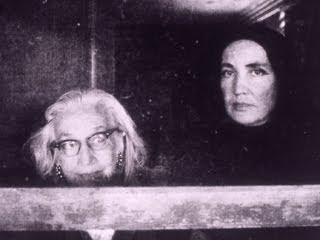
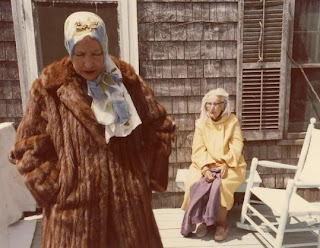
February 22, 10: 52 pm. Sitting in the kitchen riddled with spray paint fumes and sticky pasta, Erin asks Dave what he thought of Billy the Kid.
Erin: What did you think of Billy the Kid?
Dave: I didn't like it. It was really boring. It didn't go anywhere. You weren't learning anything. It was "hey, remember that kid with the wolf t-shirt and the fucked up mullet in school?" It was kind of a guilt trip movie. It goes with midddle class white people saying "oh isn't this taboo." There was nothing thought provoking. Very fishbowl; tapping the glass watching the fish swim around. I felt gross watching it. He was in the boiler room class with all the other miscreants and social outcasts pushed to the side by society. You're putting the spotlight on them like you did in school.
Erin: But didn't you find it charming at all? The kid's a performer, he seemed to enjoy the attention and worked with the camera. Everyone is acting for the camera to a certain extent.
Dave: No I didn't find it charming. I was questioning the validity of the subject matter the entire time. These are the people who used to come in to my store. They're people not spectacles. They make them out to be sideshows, freaks because we have chosen them to be for our elitist groups. We're talking about people who can't function in society. "oh look, they have feelings too." Fuck that.
Erin: Why do you think we make and watch these movies?
Dave: To feel better about ourselves, to seem interesting, to win awards, to educate others.
People fortunate enough to have an education are the only ones watching. He's smart for his age, but so what. He's not gonna have the same opportunities. He's going to have to fight his entire life. I hope he becomes happier or a performer.He's a spectacle for privelaged people to look at.
Erin: Do think all documentary film is spectacle?
Dave: It's entertainment. Especially the documentaries you are watching. Not many of them are educational. We're not watching any on the Sahara, space, or penguins; those are cut and dried. Factual. In your documentaries science and art is convoluted. Are we learning something? Is this the real world? If so what do we take from it? Why is it that the miscreants of our society are really what brings the Pulitzer home?


 And as if by divine decree, this week I also happened to read (very much coincidentally) a few essays on the construction of the Other during WWII. If anything, the readings and the film left me heavily plagued by a hatred of America and a shamefull embarassment of America's past. But then again, I am not the country I live in, or so I tell myself. I'd like to exclude myself from the national identity, whatever that may be, but the further I go with the documentary project the further I'm realizing the films I'm watching are reflections of a national identity; one of specified class, race, and socioeconomic standing favoring the white middle class. Basically, the documentaries I've been watching would have made a sensible addition to Things White People Like. All of this made me think about the frivolity of what I'm doing and how in the hell I'm getting college credit to do this. A middle class white girl from Montana attempting to "enrich" her life with stories of other middle class Americana. So this is my (re)starting point for trying to find deeper meaning, implications, and significance in the culture that has raised me. Who are making these films and for whom? How do these films reflect the shaping of an American identity? How is "otherness" exploited or countervailed in a contemporary media environment? I will attempt a discourse of these subjects and try, with as much integrity as possible, to index the class values and sensibilities of American culture through documentative media ...and all that jazz.